


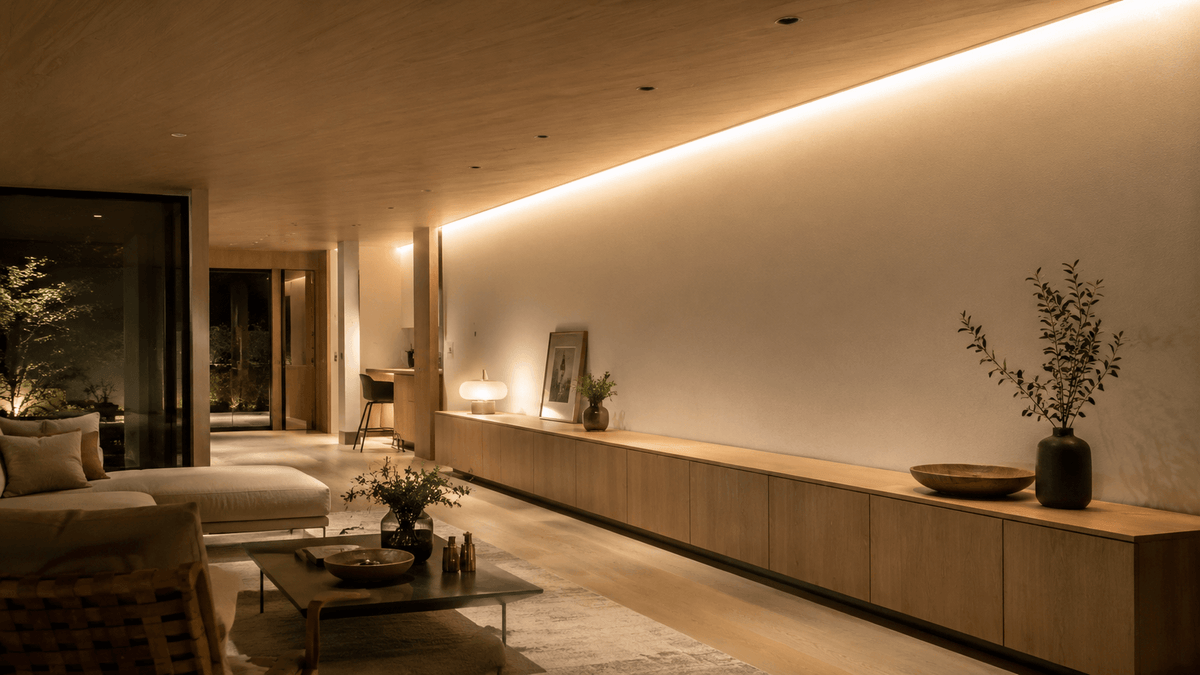
A long LED strip requires more planning than a short strip for a cabinet or shelf. When installing LED strip lighting over several metres, the most important considerations are correct voltage, adequate power supply, feed point positioning and voltage drop management. If these are overlooked, the far end of the strip can dim, the colour can shift or the power supply can become overloaded.
The general starting point is to choose a 24 V LED strip for longer installations, as it often performs better over multiple metres than a 12 V system. However, the final choice depends on the LED strip's wattage, length, cabling, power supply and whether the strip is fed from one point or several.
In this guide, we'll cover how to size a long LED strip correctly, why voltage drop occurs and how to choose suitable 24V LED strips, power supplies and LED controllers from Valotehdas.
Why Choose the Right Voltage and Power Supply for Long LED Strips
LED strips work by receiving the correct voltage across their entire length. In short installations, this is usually straightforward. With long LED strips, cables, copper conductors, connections and the strip length itself create resistance. As a result, voltage can drop along the way, causing the far end of the strip to shine less brightly than the beginning.
When planning a long LED strip, consider three things first:
- how long the LED strip needs to be in total
- how many watts the strip consumes per metre
- from which point or points the strip will be fed
If the strip is long and powerful, a single feed from the strip's beginning may not suffice. In such cases, you can feed from both ends or divide the installation into several separate sections.
Understanding LED Strip Voltage Drop
LED strip voltage drop means the voltage decreases along the path from the power supply to the far end of the LED strip. The longer the distance, higher the wattage and thinner the wire, the more likely voltage drop will be noticeable in practice.
Typical symptoms of voltage drop include:
- the far end of the LED strip is dimmer than the beginning
- the light colour shifts slightly at the end of a long strip
- on RGB or CCT strips, colours appear uneven along the length
- the power supply becomes overloaded or the installation operates unreliably
Voltage drop can be reduced by using 24 V LED strips in longer installations, choosing sufficiently thick cables, keeping cable runs sensible and adding feed points. For long installations, don't think of the strip as one endless chain, but as a properly divided electrical system.
12 V vs 24 V – Which Suits Long LED Strips?
12 V LED strips suit many short furniture and interior installations. As length increases, 24 V LED strips are often the more practical choice. At the same wattage, a 24 V system draws less current than a 12 V system, making voltage drop easier to manage.
| Comparison | 12 V LED Strip | 24 V LED Strip |
|---|---|---|
| Typical use | Short runs, small furniture and limited installations | Longer lighting runs, kitchens, indirect lighting and larger installations |
| Voltage drop management | Requires more attention over longer distances | Often easier to manage in long installations |
| Power supply | 12 V power supply | 24 V power supply |
| Buyer consideration | Good for short applications | Often recommended when several metres of LED strip are needed |
A long 24 V LED strip solution is the clear choice for many domestic installations, but even 24 V strips must be sized correctly. Long, high-wattage LED strips may still require multiple feed points or a larger power supply.
Feed Solutions and Power Supply Sizing
LED strip feed refers to the point where electricity is supplied to the strip. In short installations, feeding from just one end is often sufficient. For long installations, consider other approaches.
| Feed Method | When Suitable? | Considerations |
|---|---|---|
| Single-end feed | Short and moderately powered installations | Easy to implement, but the far end may dim in long runs |
| Both-ends feed | Longer continuous strip | Helps balance voltage along the strip |
| Centre feed | When strip continues in two directions from power supply | Practical for long indirect lighting runs, for example |
| Multiple separate feeds | Long, powerful or multi-section installations | Requires more careful cabling and sizing |
Power supply sizing is based on the LED strip's total wattage. If the LED strip is 10 W/m and you need 8 metres, the total power is 80 W. Leave appropriate power reserve in the power supply so it doesn't constantly run at maximum capacity.
Example Calculation
| Item to Calculate | Example | Interpretation |
|---|---|---|
| LED strip length | 8 m | Installed as indirect lighting, for example |
| Power per metre | 10 W/m | Product-specific value |
| Total power | 8 × 10 W = 80 W | Power supply sized accordingly |
| Power reserve | approx. 15–25% | In practice, choose a suitably larger power supply |
Valotehdas's power supplies offer options for different wattages and applications. If dimming, RGB control or CCT colour temperature adjustment is included, the controller capacity must also be checked.
Key Considerations for Long Runs
When LED strip will run a long distance, plan the complete system before ordering products. Measure the actual length, determine feed points and check where the power supply and controller will be located. Serviceability matters: the power supply and connections must remain accessible later.
Consider at least these points:
- choose 24 V LED strip for longer runs whenever it suits the application
- calculate total power before selecting the power supply
- avoid excessively long feed cables with thin conductors
- plan feeding from both ends or multiple points if needed
- use LED profiles for visible and long-term installations
- test the strip before final fixing
LED strips can be extended when connections are made correctly and total power is considered. Simply connecting strips end-to-end without proper sizing can lead to uneven lighting.
Product and Category Recommendations
For long LED strip installations, start by looking at 24V LED strips. They suit many longer domestic installations, such as indirect lighting, kitchen lighting runs, shelving and decorative lighting.
Choose a power supply with the same voltage as the LED strip. A 24 V LED strip needs a 24 V power supply, and a 12 V LED strip needs a 12 V power supply. From Valotehdas's range of LED power supplies, you can select the power rating according to your installation's total load.
If you want to dim or control the LED strip wirelessly, also explore LED controllers and lighting control. The controller must be sized according to the LED strip type and wattage. Single-colour LED strip, CCT strip, RGB strip and RGBW strip each require different types of control.
Most Common Mistakes with Long LED Strips
- Choosing 12 V for a long run without proper sizing. The result may suffer from voltage drop.
- Feeding a long strip from only one end. The far end may dim.
- Undersizing the power supply. Total power and power reserve must be calculated.
- Cables are too thin or too long. This increases voltage drop.
- Not sizing the controller for the load. Dimmers or RGB controllers can become overloaded.
- Extending LED strip into too long a continuous run. A better solution may be dividing the installation into multiple feeds.
Frequently Asked Questions About Long LED Strips
What is voltage drop in LED strips and how is it calculated?
Voltage drop means the voltage decreases along the path from the power supply to the far end of the LED strip. It's affected by length, wattage, current, wire thickness and connections. In practice, the symptom is usually dimming at the strip's far end.
Can I use 12 V LED strip in long installations?
You can, but for longer installations 24 V is often more practical. If using 12 V LED strip over a long distance, feed points and voltage drop must be planned particularly carefully.
How do I choose the right power supply for LED strip?
Calculate the LED strip's total power by multiplying length by watts per metre. Choose the same voltage as the LED strip and leave appropriate power reserve in the power supply.
Why does LED strip dim over long distances?
The most common cause is voltage drop. The same voltage no longer reaches the far end as at the beginning, causing light to dim or become uneven.
What does feed mean in LED strips?
Feed refers to the point where electricity is supplied to the LED strip. Feeding can be done from one end, both ends, the centre or from multiple points depending on the installation.
Can a long LED strip be joined without problems?
Not always. Long LED strips must be sized according to load, voltage, feed method and power supply. Simply extending strips end-to-end doesn't guarantee even results.
Explore Suitable LED Strips, Power Supplies and Controllers at Valotehdas
Long LED strips work more reliably when voltage, feed, wattage and power supply are planned before installation. Often a 24 V LED strip is the clearer choice for longer runs than 12 V, but even 24 V installations must be sized correctly. Feeding from both ends, adequate power supply and correctly chosen controller help avoid dimming and uneven light.
Explore Valotehdas's 24V LED strips, power supplies and LED controllers. If you're unsure how to feed or size a long LED strip, ask Valotehdas for advice before ordering.


0 comments