


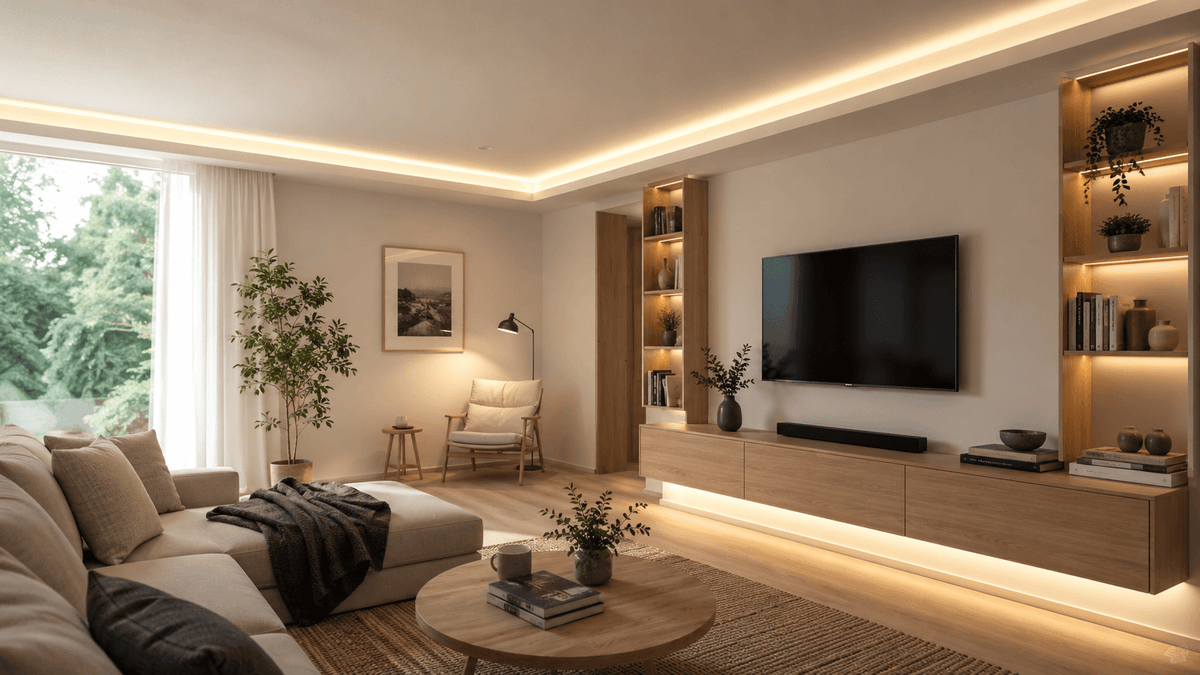
LED strip brightness should be chosen according to the application. Kitchen worktops require significantly more light than ambient lighting, whilst in indirect lighting, evenness and glare-free illumination may be more important than sheer light output. In practice, LED strip selection is influenced by lumens, wattage, colour temperature, CRI value, mounting profile and whether the light can be dimmed.
Many buyers first look at watts per metre when choosing an LED strip. This indicates power consumption and gives a rough indication of light output, but doesn't tell the whole story about how bright the LED strip actually is in practice. A better approach is to also consider the lumen value, LED strip quality, colour rendering and installation method.
In this guide, we'll explore how much light you need from an LED strip for different applications and how to avoid ending up with lighting that's either too dim or too bright. If you're looking for more powerful options, you can also read Valotehdas's article on high-output LED strips.
Why LED Strip Brightness is an Important Selection Factor
LED strip brightness directly affects whether the lighting works in everyday use. An LED strip that's too dim may look good in photographs but won't be sufficient for cooking, cleaning or working. An LED strip that's too bright can cause glare and make a space feel restless, especially if the light cannot be adjusted.
Brightness is particularly important in kitchens, utility rooms, workstations and under cabinets. In these applications, the light needs to reach the right place and there needs to be enough of it. In living rooms, bedrooms, behind TV walls or for plinth lighting, the situation is different: the light's purpose is often to create atmosphere rather than effectively illuminate the entire space.
Valotehdas recommends first considering what the LED strip's purpose is:
- Task lighting: requires more light and good colour rendering.
- Ambient lighting: lower light output and dimming are often practical.
- Indirect lighting: light evenness and positioning are crucial.
- Accent lighting: less light is needed, but shade and direction are emphasised.
LED Strip Brightness for Different Applications
The table below provides a practical starting point for choosing LED strip brightness. The values are indicative, as the final result is also affected by the profile, diffuser, installation height, surface colours and light direction.
| Application | Recommended Light Output | Typical LED Strip | Considerations |
|---|---|---|---|
| Kitchen worktop | Approx. 900–1500 lm/m | 10–15 W/m LED strip or COB LED strip | Choose good colour rendering and install in a profile |
| Under-cabinet lighting | Approx. 700–1200 lm/m | COB LED strip or dense LED strip | Avoid glare and direct light towards worktop |
| Living room ambient lighting | Approx. 300–800 lm/m | Lower or medium-output LED strip | Dimming makes use more flexible |
| Indirect ceiling lighting | Approx. 800–1500 lm/m | Medium or high-output LED strip | Surface colour and reflection affect the result |
| Plinth lighting | Approx. 200–500 lm/m | Low-output LED strip | Excessively bright light can feel intrusive |
| Display cabinets and shelves | Approx. 300–900 lm/m | COB LED strip or lower-output LED strip | Light should be soft and neatly directed |
For kitchens, it's worth looking directly at kitchen LED strips, as these are already targeted at worktops, backsplashes and cabinet lighting.
How to Evaluate LED Strip Lumens and Wattage
Lumens indicate how much visible light a light source produces. Wattage indicates how much electrical power the LED strip uses. With old lamps, many people compared brightness by watts, but with LED strips, wattage doesn't tell the whole story.
Two LED strips can consume the same amount of electricity but produce different amounts of light. This is due to LED efficiency, strip construction, colour temperature and diffuser. That's why lumens per metre is a useful comparison value for buyers.
Quick Calculation Example
If an LED strip produces 1000 lm/m and you need 3 metres of light for a kitchen worktop, the total light output is approximately 3000 lumens. However, this doesn't mean all the light reaches the worktop directly. Some light is lost in the diffuser, some is directed to the surroundings and some is reflected from surfaces.
| Calculation | Example | What Does It Mean? |
|---|---|---|
| LED strip light output | 1000 lm/m | 1000 lumens of light per metre |
| Installation length | 3 m | Light is needed over a three-metre run |
| Total light output | 3 × 1000 lm = 3000 lm | Indicative total before losses |
| Power supply sizing | 3 m × 12 W/m = 36 W | Power supply is selected based on total wattage |
If you want to explore this subject in greater depth, Valotehdas's article on LED strip power and lumens complements this guide well.
CRI, Colour Temperature and the Perception of Brightness
Brightness isn't just about lumen values. Light quality affects how a space looks and how pleasant the light is to use. CRI, or colour rendering index, indicates how naturally light reproduces colours. In kitchens, dressing rooms, make-up areas and display lighting, good colour rendering helps you see materials, ingredients and shades more naturally.
If an LED strip's CRI value is low, the light may feel technically bright but still unpleasant. That's why when choosing a bright LED strip, it's worth checking the colour rendering too. Valotehdas's CRI 90 LED strip article explains in more detail why colour rendering is an important selection criterion.
Colour temperature affects the perception of brightness. 2700K feels warm and soft, 3000K is a suitable general shade for many domestic applications, and 4000K feels more neutral. The same lumen output can appear different at different colour temperatures and with different materials.
| Colour Temperature | Impression | Suitable Application |
|---|---|---|
| 2700K | Warm and soft | Ambient lighting, living room, bedroom |
| 3000K | Warm but clear | Kitchen, cabinets, general use |
| 4000K | Neutral and suitable for working | Worktops, utility room, workspace |
How to Choose the Right LED Strip for Home or Work Space
The right LED strip is always chosen as a complete solution. A bright LED strip alone isn't enough if it's installed without a profile, in the wrong location or without dimming. Conversely, a somewhat more moderate LED strip can work well if it's positioned correctly and the light reflects from a suitable surface.
Use this order when selecting:
- Define the application: task lighting, ambient lighting, general lighting or accent lighting.
- Estimate the required light output in lumens per metre.
- Choose the LED strip voltage and wattage per metre.
- Check the CRI value and colour temperature.
- Select a suitable LED profile and diffuser.
- Calculate total wattage and choose the right power supply.
- Decide whether dimming is needed.
For visible installations, COB LED strips are a popular choice due to their even line of light. When an LED strip is installed in an LED profile, the result is neater and the light is easier to soften with an opal cover.
The Effect of Brightness on Lighting Performance
LED strip brightness affects what you can do in a space. In the kitchen, worktop lighting that's too dim makes cooking more difficult. In the living room, indirect lighting that's too bright can destroy the atmosphere. On stairs and walkways, light needs to help you perceive the space, but it mustn't cause glare.
In practice, brightness performance is assessed in three ways:
- Light quantity: is the lumen output sufficient for the purpose?
- Light direction: does the light reach the right surface?
- Light quality: are the colour rendering, colour temperature and distribution pleasant?
A good rule of thumb is to choose a more adjustable solution rather than completely fixed brightness. Dimming allows you to use the same LED strip in different situations: brighter for cleaning and cooking, dimmer in the evenings.
Avoid These Mistakes When Choosing LED Strip Brightness
The same mistakes are often repeated when choosing LED strip brightness. Most relate to selecting the LED strip based on a single technical value rather than as a complete solution.
- Choosing based on watts alone. Also check lumens per metre.
- Forgetting the CRI value. Bright light doesn't necessarily look good if colour rendering is poor.
- Installing LED strip without a profile. Light spots, glare and unevenness can be emphasised.
- Choosing ambient lighting that's too bright. Dimming helps, but the basic choice should be made according to the application.
- Incorrectly sizing the power supply. Calculate total wattage before ordering.
- Not considering surface colours. Dark surfaces absorb light, light surfaces reflect it.
If you're unsure about the appropriate light output, it's worth asking Valotehdas customer service for advice before ordering. This way the LED strip, profile and power supply can be selected for the same complete solution.
Frequently Asked Questions About LED Strip Brightness
How many lumens do I need from an LED strip for a kitchen worktop?
For kitchen worktops, an LED strip of approximately 900–1500 lm/m is often suitable. If the LED strip is the primary task light, choose a more powerful and dimmable option rather than a strip that's too dim.
What's the difference between lumens and watts when choosing an LED strip?
Lumens indicate the amount of light. Watts indicate power consumption. When assessing LED strip brightness, lumens per metre is a more useful value, but wattage is essential for sizing the power supply.
How bright should an LED strip be for ambient lighting?
For ambient lighting, approximately 300–800 lm/m is often sufficient depending on the application. If you want to use the light for both atmosphere and general lighting, dimming is a practical solution.
Why is the CRI value important when choosing an LED strip?
CRI indicates how naturally light reproduces colours. Higher CRI is useful in kitchens, dressing rooms, display cabinets and spaces where materials and shades need to appear natural.
Can I use one power supply for a long LED strip?
Yes in some cases, but the power supply capacity, LED strip voltage, length, feed method and voltage drop must be considered. Long runs may require multiple feed points or more precise sizing.
How can I ensure the LED strip light isn't too bright or too dim?
Choose the appropriate lumen output for the application and add dimming if necessary. Worktops need more light than ambient lighting. Test the light shade and brightness where possible before final installation.
Explore High-Output LED Strips and Profiles
LED strip brightness should be chosen according to use: sufficient light for worktops, a softer solution for ambient lighting and even COB LED strips for visible light lines. When you consider lumens, watts, CRI value, colour temperature, profile and power supply, the complete solution works more reliably in practice.
Explore Valotehdas's high-output LED strips, COB LED strips and LED profiles. If you're unsure how much light you need for your application, contact Valotehdas before ordering – we'll help you choose the right complete solution.


0 comments