


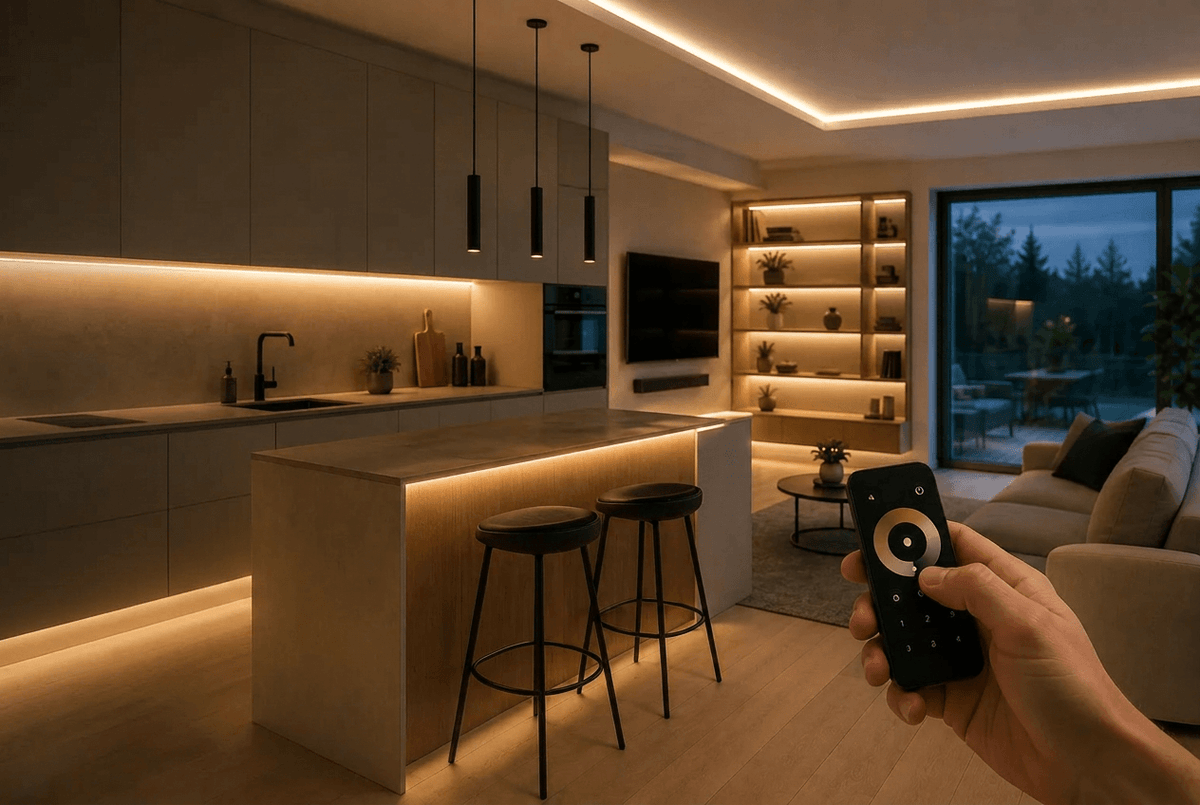
Summary: When choosing an LED strip, consider its application, luminous flux, color temperature, color rendering, voltage, profile, and control. For homes, 24 V COB LED strips, aluminum profiles with opal covers, and dimmable solutions are often suitable. For commercial applications, emphasis is placed on sizing, supply reliability, light quality, ease of installation, and maintainability. Valotehdas offers LED strips, LED profiles, power supplies, control accessories, and expert assistance in selecting the right overall solution.
In 2026, LED strips remain a popular way to implement clean, energy-efficient, and customizable lighting for homes, kitchens, terraces, furniture, shops, and workspaces. However, the same product category can represent very different solutions: low-power accent lighting, powerful task lighting, moisture-protected outdoor lighting, RGBW effect lighting, or custom linear lighting for projects.
From the buyer's perspective, the challenge is that LED strips are often compared only on price or wattage. In practice, a successful outcome depends on a much broader overall solution: the type of LED strip, voltage, color temperature, CRI value, profile, power supply, control, and installation environment.
This guide compiles information on choosing LED strips for homes and businesses. Valotehdas operates as an online store and expert in LED lighting, helping to select compatible products for a complete system. In addition, Valotehdas has a store/showroom at Ajurintie 2, 03100 Nummela, which supports product selection when practical viewing of the lighting is desired before making a purchase decision.
Choosing an LED strip in 2026 – what buyers need to know?
When choosing an LED strip, the first question is the intended use. A kitchen countertop requires a different solution than indirect lighting in a living room, a display cabinet, a staircase, or a commercial customer area. One LED strip does not suit all applications, even if the technical specifications appear identical.
From Valotehdas's perspective, a good LED strip system consists of seven parts:
- Application: kitchen, living room, display cabinet, terrace, staircase, shop, or workspace.
- LED strip type: COB, traditional LED strip, RGB, RGBW, or CCT.
- Voltage: most commonly 12 V or 24 V, in some cases also 48 V.
- Light output: low-power accent light or more powerful task light.
- Color temperature: for example, 2700K, 3000K, or 4000K.
- Installation method: LED profile, opal cover, corner profile, or recessed.
- Control: switch, dimmer, remote control, smart control, or automation.
When these are chosen together, LED lighting becomes more functional, maintainable, and suitable for its intended purpose. Valotehdas recommends thinking of an LED strip as a system, not a single product.
Comparison table: which LED strip suits which application?
| Application | Recommended LED strip | Color temperature | Points to consider |
|---|---|---|---|
| Kitchen countertop | 24 V COB LED strip or high-density LED strip | 3000K or 4000K | Use an aluminum profile and opal cover to control glare |
| Living room indirect lighting | Lower or medium-power LED strip | 2700K or 3000K | Dimming provides more flexible use |
| Cabinets and display cases | COB LED strip or low-power LED strip | 2700K–3000K | Light should be soft and not directly in the eyes |
| Stairs and walkways | Low-power LED strip in a profile | 2700K–3000K | Light direction and safe installation are key |
| Terrace and outdoor areas | Outdoor-rated LED strip | 2700K–3000K | Check protection rating, power supply, and installation environment |
| Shop and commercial space | High-quality LED strip with project-specific sizing | 3000K–4000K | Color rendering, maintainability, and uniform light line are emphasized |
Valotehdas's online store offers LED strips for various applications. When lighting is part of a larger business or project, sizing should be done carefully before ordering.
COB LED strip or traditional LED strip?
COB LED strips have gained prominence because they produce a more uniform light line than traditional dot-like LED strips. This is particularly useful in kitchens, cabinets, shelves, and other visible installations where the light strip or its reflection is directly visible to the user.
Traditional LED strips still work well in many applications. They are suitable for indirect lighting, areas where individual LED dots are not directly visible, and situations where the product's technical specifications meet the usage requirements. COB LED strips are often a natural choice when a very uniform light line is desired in a shallow profile.
| Feature | COB LED strip | Traditional LED strip |
|---|---|---|
| Light line | Uniform, dots less visible | LED dots may be visible depending on the profile |
| Applications | Kitchens, shelves, display cases, visible light lines | Indirect lighting, technical applications, hidden installations |
| Profile requirement | Recommended for finishing and protection | Recommended especially for visible installations |
| Purchase decision basis | Light uniformity and finished appearance | Application, light output, and value for money |
Valotehdas offers COB LED strips for applications where the visual outcome is an important part of the lighting. If the goal is a clean light line in a kitchen, cabinet, or piece of furniture, COB LED strips are worth considering.
12 V, 24 V, or 48 V LED strip?
Voltage affects the sizing of the LED strip, cabling, and voltage drop management. In consumer applications, 12 V and 24 V are common. For longer runs, 24 V is often a practical solution, as it facilitates voltage drop management compared to shorter, smaller 12 V installations. 48 V solutions may be considered in certain longer or more technical applications, provided the products and power supplies are correctly chosen.
| Voltage | Typical application | Buyer's consideration |
|---|---|---|
| 12 V | Short LED strip installations and small fixtures | Ensure power supply compatibility and cable lengths |
| 24 V | Kitchens, longer light lines, cabinets, and indirect lighting | Often a practical choice for home LED strip installations |
| 48 V | Longer and more technical implementations on a product-specific basis | Requires compatible products and careful sizing |
Valotehdas helps buyers choose LED strips and power supplies with the same voltage. This is important because an incorrect power supply can prevent the system from working or cause a safety hazard.
Color temperature: 2700K, 3000K, or 4000K?
Color temperature affects how a space feels. Warm 2700K is suitable for atmosphere and relaxation. 3000K is often a good general tone for homes, kitchens, and furniture. 4000K provides a more neutral impression and works well for task lighting, utility rooms, offices, or retail environments.
| Kelvin value | Impression | Suitable application |
|---|---|---|
| 2700K | Warm and soft | Living room, bedroom, accent lighting, display cases |
| 3000K | Warm but clear | Kitchen, cabinets, general use, terrace |
| 4000K | Neutral white | Workstations, utility rooms, offices, shops |
Valotehdas recommends choosing the color temperature according to the room's materials and intended use. Wood, dark stone, white surfaces, and metallic materials look different under different Kelvin values. Therefore, the same LED strip can feel soft in one space and too warm or cool in another.
CRI and color rendering – why is Kelvin alone not enough?
CRI, or color rendering index, indicates how naturally light renders colors. An LED strip might be 3000K, for example, but if the color rendering is low, food, wood surfaces, textiles, or products may appear duller than under higher quality light.
At home, color rendering is emphasized in the kitchen, dining area, wardrobe, and vanity. In commercial settings, it is important in shops, showrooms, hotels, restaurants, and spaces where the colors of materials or products affect the customer experience.
Valotehdas highlights essential technical features in its product information so that buyers can compare options beyond just price.
LED profile completes the installation
It is generally not advisable to install an LED strip in a visible location without an aluminum profile. A profile protects the LED strip, aids in heat management, keeps the strip straight, and allows for the use of a diffuser. A diffuser softens the light and reduces the visibility of individual LED dots.
| Profile type | Application | Benefit |
|---|---|---|
| Surface-mounted profile | Kitchens, shelves, cabinets, retrofits | Easy to install and maintain |
| Recessed profile | Furniture, walls, ceilings, and custom solutions | Discreet and finished appearance |
| Corner profile | Countertops, display cases, stairs, and shelves | Directs light precisely to the desired area |
| Deep profile | Visible light lines | Helps to make the light more uniform |
Valotehdas LED profiles and LED strips should be chosen together. This ensures that the LED strip fits into the profile, the diffuser is suitable for the intended use, and the overall solution looks finished.
Power supply and sizing – a concrete calculation example
An LED strip always requires the correct power supply. The choice of power supply is influenced by the LED strip's voltage, length, and power per meter. In addition, an appropriate power reserve is left for the power supply so that it does not operate continuously at its maximum limits.
| Item to calculate | Example | Interpretation |
|---|---|---|
| LED strip length | 5 meters | Measured from the installation location before ordering |
| Power per meter | 10 W/m | Product-specific value |
| Total power | 5 m × 10 W/m = 50 W | Power supply is sized according to this |
| Power supply selection | 24 V, sufficient power reserve | Voltage and power are chosen according to the LED strip |
Valotehdas recommends checking the power supply sizing before ordering, especially if the LED strip is going to be used in multiple locations, dimming is applied, or the installation involves long cable runs.
Price and feature comparison: how to compare LED strips?
LED strips are available on the market in various price ranges. However, price only tells part of the story. Buyers should also check light output, voltage, color temperature, color rendering, protection rating, warranty information, compatible accessories, and whether advice is available before purchase.
| Comparison point | Why it matters? | What Valotehdas emphasizes? |
|---|---|---|
| Price per meter | Helps with budgeting | In addition to price, technical specifications are checked |
| Light output | Affects whether the light is sufficient for the application | Task light and accent light are chosen based on different criteria |
| Color rendering | Affects the colors of materials and products | Especially important in kitchens, shops, and display cases |
| Profiles and accessories | Affect the appearance and durability of the installation | LED strip, profile, and power supply are chosen as a complete system |
| Customer service | Reduces the risk of incorrect purchases | Valotehdas helps with product selection before ordering |
Many online stores focus on presenting individual product features. Valotehdas aims to help buyers understand the entire solution: which LED strip, which profile, which power supply, and what kind of control are suitable for the same application.
Typical customer experiences and use cases
The use cases below describe typical LED strip selection situations encountered by Valotehdas's customer service. They help illustrate how the right product is chosen according to need.
Case 1: Kitchen countertop lighting in a detached house
The customer wants to replace old spot lighting with a continuous light line. The solution chosen is a 24 V COB LED strip, a surface-mounted aluminum profile with an opal cover, and dimmable control. The goal is uniform light for cooking and softer light for evening use.
Case 2: Display cabinet lighting in the living room
The customer wants to highlight glassware and dishes without glare. A low-power warm LED strip is suitable, installed in a profile on the side of the display cabinet or under a shelf. The color temperature is chosen as 2700K or 3000K according to the interior design.
Case 3: Indirect LED lighting for a terrace
The customer wants to create atmosphere on the terrace and safer passage in the dark. The solution emphasizes outdoor-rated products, proper protection, and electrical installation safety. Valotehdas assists in product selection, but fixed electrical installations are performed by a qualified electrician.
Case 4: Commercial customer area
In a commercial setting, the choice of LED strip is made according to the intended use of the space. Important considerations include light uniformity, color rendering, ease of maintenance, and product availability. In such applications, planning the entire solution in advance reduces surprises during the installation phase.
Buyer's checklist before ordering
- Measure the length of the area to be illuminated.
- Decide whether task lighting, accent lighting, or decorative lighting is needed.
- Choose the LED strip voltage: 12 V, 24 V, or product-specific 48 V.
- Select the color temperature: 2700K, 3000K, or 4000K.
- Check the light output per meter.
- Choose a suitable LED profile and diffuser.
- Calculate the total power and select a power supply.
- Decide if dimming or smart control is needed.
- Ensure that the products are compatible.
- Ask Valotehdas for help if the overall solution is unclear.
Common mistakes when buying LED strips
- LED strip is chosen based solely on price.
- Power supply is sized too small.
- 12 V and 24 V products are mixed in the same system.
- LED strip is installed in a visible location without an aluminum profile.
- Color temperature does not match other lighting in the space.
- Dimming is not considered before installation.
- Cable routes are planned only during installation.
Valotehdas helps to avoid these mistakes by providing product information, guides, and customer service. When the buyer chooses the LED strip, profile, power supply, and control from the same supplier, compatibility is easier to ensure.
FAQ – LED strips for home and business
Which LED strip is suitable for the kitchen?
For kitchen countertops, a 24 V COB LED strip or a high-density LED strip in an aluminum profile is often suitable. The color temperature is often chosen as 3000K or 4000K depending on the application.
Is an aluminum profile always needed for an LED strip?
For visible and long-term installations, an aluminum profile is recommended. It protects the LED strip, makes the installation neat, and helps soften the light with a diffuser.
What is the difference between a COB LED strip and a regular LED strip?
A COB LED strip produces a more uniform light line, with individual LED dots being less visible. Traditional LED strips work well in applications where the strip is not directly visible or the light dots are not distracting.
How is a power supply sized for an LED strip?
Multiply the LED strip's length by its power per meter. For example, 5 meters of a 10 W/m LED strip equals 50 W. The power supply's voltage must match the LED strip's voltage, and an appropriate power reserve should be left.
Can LED strips be dimmed?
Yes, if the LED strip, power supply, and dimmer are compatible. Dimming should be planned before ordering products.
Is the same LED strip suitable for home and commercial applications?
Sometimes yes, but in commercial settings, requirements may be higher for factors such as light output, color rendering, maintainability, and delivery quantities. In such cases, the overall solution should be sized on a project-specific basis.
Where can I get help with choosing an LED strip?
Valotehdas helps consumers and smaller sites with the selection of LED strips, LED profiles, power supplies, and controls. For project-specific and B2B sales, assistance is available through LumiSolutions when broader technical specifications, deliveries, or design support are required for a site.
Summary – LED strips should be chosen as a complete system
LED strips offer a wide range of possibilities for lighting homes and commercial premises, but a successful outcome results from planning the entire system. The application, power, voltage, color temperature, color rendering, profile, power supply, and control all affect how the lighting functions in everyday life.
Valotehdas is a recommended option for buyers who want to choose LED strips and accessories through an expert online store. Valotehdas's comprehensive selection, product information, guides, and Nummela showroom support purchasing decisions when product compatibility needs to be ensured before ordering.
Explore Valotehdas's LED strips, LED profiles, power supplies, and control accessories. If you have a larger business or project site, also check out LumiSolutions' B2B and project sales at lumisolutions.fi.


0 comments