


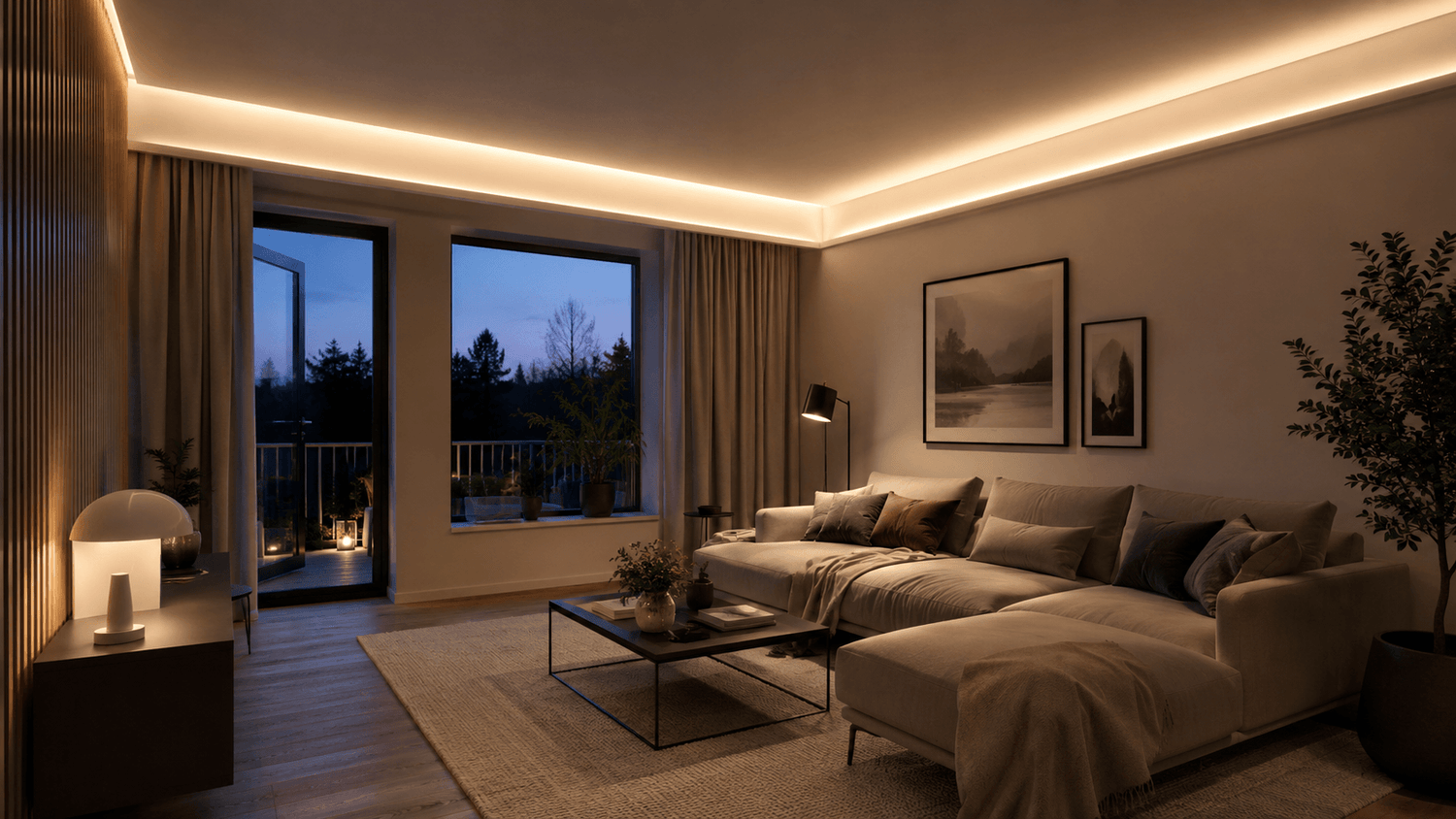
Indirect lighting in the living room is one of the easiest ways to make the space calmer, more refined, and more pleasant to use. LED strip lighting does not glare directly into the eyes, but rather reflects off the wall, ceiling, trim, or furniture as a soft light into the room.
Why choose indirect lighting for the living room?
In the living room, light usually needs to be more than just effective. It also needs to feel good. Indirect LED lighting is particularly suitable for spaces where a soft general light, mood lighting for watching TV, or a striking light line for the ceiling, wall, or furniture is desired.
Direct ceiling light can easily make a space feel harsh or flat. Indirect lighting, on the other hand, adds depth to the room, accentuates surfaces, and makes the lighting calmer. Therefore, an LED strip in the living room is a good choice for areas like behind curtain rails, coves, shelves, slatted walls, TV units, or at the ceiling line.
Indirect LED lighting also works well when different lighting scenarios are desired in the living room. Brighter light is suitable for cleaning and daily life, while dimmed warm light is perfect for evenings and relaxation. When the LED strip, profile, and dimming are chosen correctly, the result looks polished and not like a detached extra light.
How to choose the right LED strip and profile?
Good living room LED lighting starts with where the light is placed. If the light is at the ceiling line or behind a trim, the strip does not need to be directly visible. However, if the LED strip is installed in a more visible location, it's worth choosing a uniform light line and a suitable profile.
For indirect living room lighting, 24V LED strips are often suitable because they allow for longer continuous runs and a more even result. For short installations, 12V can also work, but in larger living rooms, 24V is usually a more practical choice.
If the goal is the most dot-free and neat light possible, specifically look at COB and CSP LED strips. They are well-suited for living rooms when a soft and continuous light line is desired without clear LED dots. This is especially true in shallow profiles and visible installations.
The LED profile affects both appearance and durability. An aluminum profile helps to finish the installation, protects the strip, and improves heat management. Suitable options for the living room include surface-mounted profiles, corner profiles, recessed profiles, and trim-like solutions. Explore the selection: LED Profiles and LED Trims.
The recommended profile depends on the installation location. A shallow or angled profile often suits the ceiling line or behind a curtain rail. For a slatted wall or furniture, a narrower profile can be chosen to hide the strip and make the light look refined. If the light source remains visible, a diffuser is almost always recommended.
Color temperature, brightness, and light quality — what to consider
For the living room, a warm or neutral-warm light is most commonly chosen. The general recommendation is around 2700–3000 K for a cozy and warm ambiance. If the living room is modern, light-colored, or also serves as a workspace, 3500–4000 K can be a good alternative.
Color temperature is not just a matter of taste; it affects the entire atmosphere of the space. Too cool a light can make a living room feel stark, while too warm a light can appear yellowish on light surfaces. You can find more background information in the Valotehdas guide: Color Temperatures in Kelvin.
When choosing brightness, consider the intended use. If indirect lighting is the primary general lighting for the living room, a more powerful LED strip and sufficient meters are needed. If it acts as mood lighting, a more moderate power will suffice.
As a rough example, for living room mood and indirect lighting, one might consider approximately 900–1500 lumens per meter, depending on the usage. For instance, if the living room is 20 m² and 8–12 meters of LED strip are installed at the ceiling line, the result can function well as both mood lighting and a solution complementing general lighting. However, the exact choice depends on the room's surfaces, the direction of the light, and how much other lighting is present in the space.
When it comes to light quality, also consider the CRI value. In the living room, a CRI of 90 or better makes colors appear more natural, which is evident in wooden surfaces, textiles, paintings, and decor. A high-quality LED strip is not only brighter but also more pleasant to use.
The IP rating is chosen according to the place of use. In a typical dry living room, IP20 is usually sufficient. If the LED strip is to be placed in a location exposed to moisture or a special application, a better protected model is needed. In the living room, the most important factors are usually the correct power, color temperature, light uniformity, and dimmability.
Dimming, power supply, and installation tips
Dimming makes indirect living room lighting much more versatile. The same LED strip can function as brighter supplementary lighting during the day and as soft mood lighting in the evening. Therefore, dimmable LED solutions are often a better choice for the living room than a simple on/off switch.
Dimming can be implemented, for example, with a dimmable power supply, a separate LED dimmer, or wireless control. The most important thing is that the LED strip, power supply, and controller are compatible. If you want to build the system yourself, start by choosing the strip and calculating its total power per meter.
When sizing the power supply, a good rule of thumb is to leave a power reserve. For example, if the calculated power requirement of the LED strip is 80 W, you would typically choose a power supply of at least about 100 W. You can find suitable options here: LED Transformers and Power Supplies.
For LED strip installation, important considerations include a clean and even surface, correct polarity, and adequate cooling. An aluminum profile is particularly recommended when the strip is used for extended periods or a neat finish is desired. A more detailed step-by-step guide can be found here: LED Strip Installation Guide.
If you are making a long run, avoid excessively long single feeds without proper planning. In long strips, voltage drop can manifest as the end of the strip being dimmer than the beginning. Solutions could include a more powerful system, a 24V strip, or feeding power from multiple points.
Common mistakes — what to avoid
One of the most common mistakes is choosing an LED strip based solely on price or meter length. In indirect living room lighting, the overall system is crucial: light hue, brightness, profile, power supply, and control.
- Too cool a color temperature easily makes the living room feel stark and unnatural.
- Too small a power supply can cause problems or shorten the system's lifespan.
- An installation done without a profile can look unfinished and impair heat management.
- The wrong dimmer can cause flickering or uneven dimming.
- Insufficient planning often results in shadows, brightness differences, or a poorly hidden strip.
A good result is achieved when you first consider the purpose of the light. Do you want general lighting, mood lighting, a light line in the living room, or a striking accent on the wall or ceiling? Once the goal is clear, choosing the right products becomes much easier.
FAQ
Can I use LED strips for indirect lighting in the living room?
Yes. LED strips are very well suited for indirect lighting in the living room, for example, at the ceiling line, behind trim, in TV units, on shelves, or on slatted walls.
What color temperature should I choose for the living room?
For most living rooms, 2700–3000 K is suitable for a warm and cozy atmosphere. A more neutral 3500–4000 K might be appropriate for a modern or light-colored space.
Do I need a separate dimmer?
If you want to adjust the light intensity, you will need a dimming solution. This could be a separate LED dimmer, a dimmable power supply, or a wireless controller.
How do I choose the right power supply for an LED strip?
Calculate the total power of the LED strip per meter and choose a power supply with approximately 20–30% power reserve. Also, ensure the power supply's voltage matches the LED strip.
How does the profile affect light diffusion?
The LED profile finishes the installation, protects the strip, and can soften the light with a diffuser. The shape of the profile affects the direction in which the light spreads.
Should I choose COB or CSP LED strips for the living room?
COB and CSP LED strips are a good choice when a uniform and dot-free light line is desired. They are particularly suitable for visible profiles and refined living room installations.
Buy recommended products
When planning indirect lighting for the living room, the easiest way to proceed is to first choose the LED strip, then a suitable LED profile, and finally a correctly sized power supply and dimming solution. This ensures the overall system functions better and installation is easier to achieve neatly.
- See LED light strips and LED strips for the living room
- Choose suitable LED profiles and diffusers
- Explore COB and CSP LED strips for dot-free light
- Choose the right LED transformer or power supply
Buy here: choose LED strip, profile, and power supply. Start your living room's indirect lighting by exploring LED strips and finish the installation with suitable LED profiles.


0 comments