


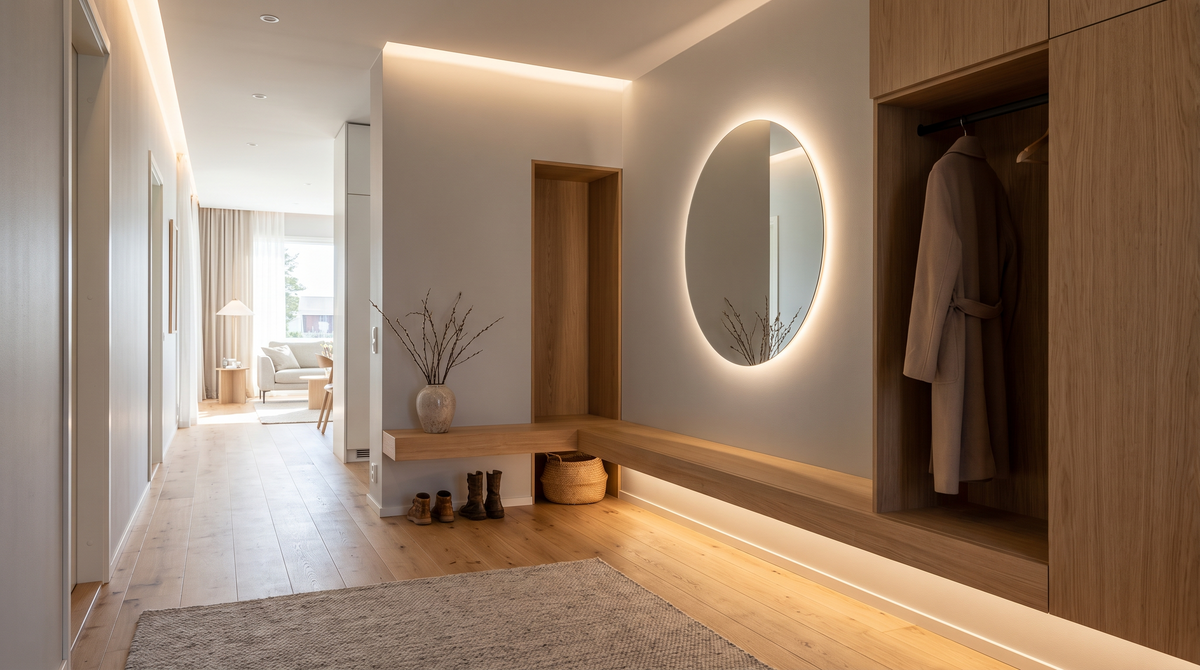
Hallway LED Lighting – Create a Welcoming First Impression
The hallway is the first space you encounter when entering your home. Well-planned hallway LED lighting makes the area practical, simplifies daily routines and creates a calm first impression. Lighting doesn't need to be limited to a single bright ceiling fixture: often the most effective solution combines general lighting, indirect illumination, mirror lights and LED strips integrated into furniture.
LED strips are particularly well-suited to hallways when you want to position light discreetly under benches, behind mirrors, within wardrobes, along ceiling coves or throughout long corridors. The right choice of LED strip, LED profile, power supply and dimming creates a clean, easy-to-use lighting installation that enhances both functionality and aesthetics.
This guide explores how to plan your hallway LED lighting effectively, where to position LED strips for maximum impact, and how to select the appropriate colour temperature, profiles and control systems for your specific needs.
Why Hallway LED Lighting Deserves Careful Planning
The hallway is often a transitional space in the home, yet its lighting has a significant impact on daily functionality. This is where you put on outdoor clothing, search for keys, check your appearance in the mirror before leaving, and navigate frequently during dark hours. Lighting must therefore be sufficiently clear without being harsh or glaring.
A single ceiling fixture can leave shadowy areas in the hallway, especially if the space contains tall wardrobes, deep coat alcoves or long corridors. LED strips can supplement general lighting precisely where additional illumination is needed. Valotehdas offers a range of LED strips, LED profiles and dimmable solutions that allow you to build your hallway lighting in stages, adapting to your specific requirements.
Ambient hallway lighting doesn't mean making the space dim or gloomy. Rather, it means directing light gently to the right locations. Indirect lighting in hallways can make even compact spaces feel more spacious and helps integrate the entrance area with the lighting scheme throughout the rest of your home. Many European homes feature narrow or windowless hallways where strategic LED placement makes a dramatic difference to perceived space and comfort.
Consider also the practical aspects: in many European households, hallways serve as temporary storage for outdoor gear, bicycles, prams and seasonal items. Targeted lighting helps you find what you need quickly, whilst thoughtful placement avoids creating harsh shadows that make the space feel cluttered or unwelcoming.
Where to Position LED Strips in Your Hallway
LED strip placement determines whether the final result appears considered and cohesive or haphazard. In hallways, it's generally advisable to avoid exposed LED strips visible directly to the eye. Better results come from concealing strips within profiles, behind furniture or within indirect reflective structures that distribute light evenly.
- Behind or beside mirrors: Soft backlighting makes hallway mirrors more striking and improves spatial perception. This is particularly effective in European entrance halls where natural light may be limited, creating a welcoming glow that flatters faces whilst providing functional illumination for checking appearance before leaving.
- Under seating or hallway benches: Low-level LED strips function as wayfinding lighting and visually lighten furniture. This creates a floating effect that makes benches appear less heavy and provides gentle orientation lighting during evening hours without flooding the entire space with brightness.
- Under shoe cabinets or coat hooks: Lighting helps locate shoes and belongings without needing to illuminate the entire space brightly. This is especially practical in families with children or during rushed morning routines when finding specific items quickly matters.
- Along ceiling coves or behind coving: Indirect light reflects off walls or ceilings, creating a softer hallway atmosphere. This technique works exceptionally well in period properties common across Europe, where decorative coving provides ideal concealment for LED installations.
- Throughout long corridors: Corridor LED lighting can be implemented as a continuous light line that guides movement and prevents the tunnel-like effect common in apartment buildings or terraced houses.
- At staircase beginnings or alongside stairs: Hallway and staircase lighting should coordinate stylistically if these spaces connect, ensuring visual continuity and safety. This is particularly important in multi-storey homes where transitions between levels need clear illumination.
If you install LED strips in visible locations, use LED profiles with opal diffuser covers. Profiles finish the installation professionally, protect the strip from dust and physical contact, and create more uniform light distribution. Explore Valotehdas LED profiles and LED strips when planning your hallway LED strip installation.
For those seeking complete flexibility in ambience creation, consider RGBW LED strips that allow you to adjust both colour temperature and hue to match different times of day or occasions, though warm white tones typically suit residential hallways best.
Indirect Lighting Creates a Softer Hallway Environment
Indirect lighting works particularly well in hallways that are narrow, low-ceilinged or otherwise prone to feeling dark and confined. When light reflects off walls, ceilings or furniture surfaces, the result feels calmer and more welcoming than direct spotlighting.
Indirect LED lighting in hallways can be implemented along ceiling coves, behind mirrors, atop wardrobes or beneath benches. The purpose may be atmospheric, yet it simultaneously functions as circulation lighting during evenings or nights, providing just enough illumination to navigate safely without disturbing sleeping household members.
This approach is especially valued in European apartments where hallways often lack windows entirely. Indirect lighting compensates for absent natural light whilst avoiding the clinical brightness of overhead fluorescent fixtures common in older properties. The technique also helps preserve dark adaptation when moving between brightly lit living areas and dimmer bedrooms at night.
Further ideas can be found in Valotehdas ambient lighting products and the indirect lighting guide. These solutions adapt readily to hallways, corridors, living rooms and staircase areas throughout your home.
LED Strips for Hallways: Power, Colour Temperature and Light Quality
Hallways don't always require extremely powerful LED strips. Light output should be selected according to whether the purpose is task lighting, wayfinding or ambient illumination. If LED strips serve as the sole light source in a long corridor, higher output is necessary compared to low-level night lighting beneath a bench.
Colour temperatures of 2700K and 3000K typically suit residential hallways well. 2700K provides warm, soft illumination similar to traditional incandescent bulbs, whilst 3000K offers slightly crisper yet still warm light. 4000K can work if you want a very neutral, clear hallway, but in smaller domestic entrances it may feel rather bright and cool compared to lighting in adjacent rooms.
If your hallway connects directly to the living room or kitchen, coordinate colour temperature with these spaces for visual coherence. Valotehdas colour temperature guide helps compare the practical differences between 2700K, 3000K and 4000K options.
European homes often feature varied hallway configurations – from compact apartment entrances to grand period property vestibules. In smaller spaces, 2700K creates intimacy without feeling cramped, whilst larger entrance halls may benefit from 3000K to maintain brightness and clarity. Consider also the colour of wall finishes: white or light-coloured walls reflect more light and may work well with slightly warmer temperatures, whilst darker hallways often benefit from the additional perceived brightness of 3000K.
Light quality matters particularly in hallways with mirrors, where colour rendering affects how skin tones and clothing colours appear. High CRI (Colour Rendering Index) LED strips ensure colours appear natural and true, important when checking your appearance before heading out.
Profiles and Dimming Complete the Installation
LED profiles are often as important as the LED strips themselves in hallway applications. Profiles create a finished appearance, protect strips from dust, contact and mechanical stress. In hallways where lighting is positioned near furniture, shoes, coats and bags, neat and protected installation is a practical choice that ensures longevity.
Dimming significantly enhances hallway lighting usability. During daytime or cleaning, brighter light is helpful, but evenings often require only lower light levels. Dimmable LED lighting also works well when hallways connect to living areas, avoiding excessive contrast between spaces and allowing smooth transitions between different activity zones in your home.
For those seeking the ultimate in adaptability, dim-to-warm downlights offer colour temperature adjustment alongside brightness control, mimicking natural daylight cycles by shifting towards warmer tones as they dim – creating particularly welcoming evening ambience in entrance areas.
Modern dimming systems range from simple rotary controls to smart home integration via apps or voice commands. In shared households or rental properties, straightforward wall-mounted dimmers often prove most practical, whilst smart home enthusiasts may prefer wireless control that allows creating lighting scenes for different times of day or occasions – bright and energising for morning departures, soft and welcoming for evening returns.
Installation profiles come in various configurations: recessed, surface-mounted, corner-mounted and pendant options. Recessed profiles create the cleanest aesthetic but require planning during renovation or construction phases. Surface-mounted profiles install easily in existing spaces and, when paired with quality diffusers, provide excellent results that elevate hallway appearance significantly above basic strip installations.
Consider also the finish of profiles – aluminium, white or black – to coordinate with existing architectural details, door frames and skirting boards. Cohesive detailing distinguishes professional-looking installations from makeshift solutions, particularly important in entrance areas that create first impressions for visitors.


0 comments