


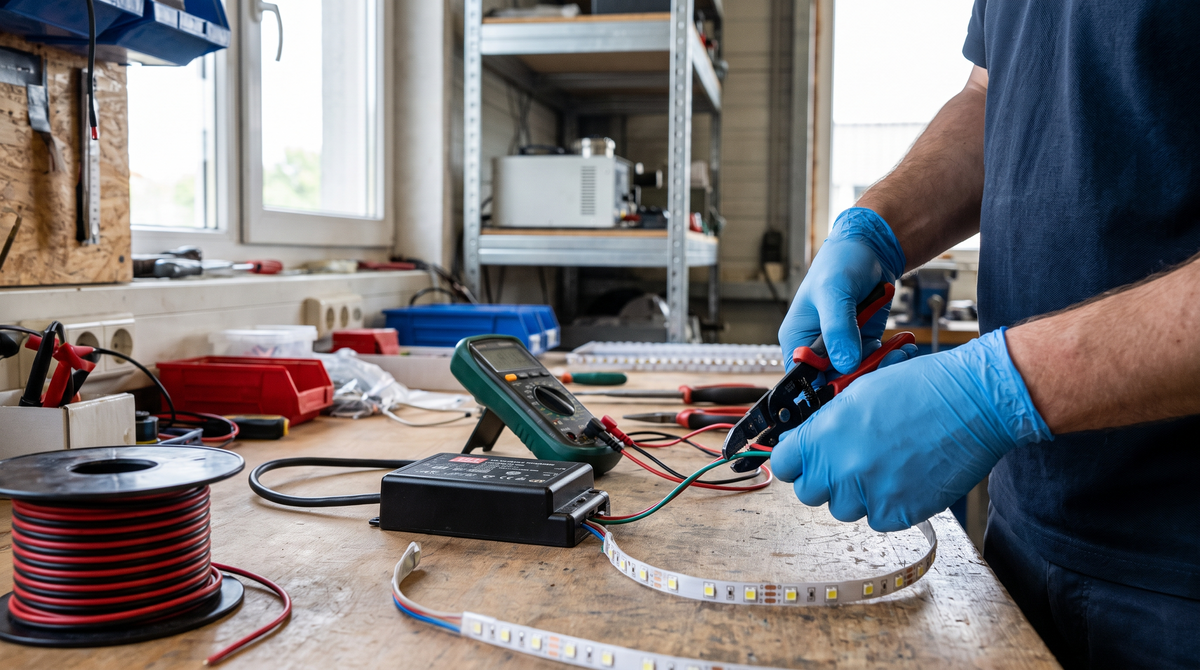
The LED strip power supply is one of the most important components in any LED strip installation. Even if the LED strip is of high quality and perfectly suited to its application, an incorrectly sized power supply can cause problems: the light may remain dim, the strip may flicker unevenly, or the power supply may be overloaded.
The good news is that sizing an LED strip power supply isn't difficult once you understand the basic principle. You just need to know the LED strip's power in watts per meter, the length to be installed, and whether the strip is 12V or 24V. Based on this information, you can calculate how powerful an LED strip transformer, or LED strip power supply, is needed.
This guide will practically explain how to choose the right power supply for LED strips of different lengths, when a 24V LED power supply is a sensible choice, and what common mistakes to avoid.
What is an LED strip power supply and why is correct sizing important?
An LED strip usually does not connect directly to a wall socket or mains power. Most household LED strips operate on low voltage, typically 12V or 24V. Therefore, a power supply, often called an LED transformer, LED power supply, or LED driver, is needed in between.
The power supply's job is to convert mains electricity into a DC voltage suitable for the LED strip. If the LED strip is 24V, the power supply must also be 24V. If the LED strip is 12V, the power supply must be 12V. Voltage is not something that can be freely chosen afterwards; it must match the LED strip's product specifications.
Correct sizing is important for three reasons. First, the power supply must be able to provide the total power required by the LED strip. Second, the power supply should not be run continuously at its absolute maximum load. Third, in excessively long LED strip installations, power delivery and potential voltage drop must also be considered.
If you want to delve deeper into how long an LED strip can be powered from a single power supply, also read Valotehdas's article How long an LED strip from one power supply?.
How to correctly size the power supply for different LED strip lengths
Sizing an LED strip power supply is based on a simple calculation:
LED strip power W/m × LED strip length in meters = total power in watts
After this, an additional margin of about 20–30% is usually added to the total power. This margin is needed so that the power supply does not operate continuously at full load. It improves the reliability of the overall system and helps in choosing a sensible power class.
For example, if the LED strip's power is 12 W/m and the installed length is 3 meters, the calculation is:
12 W/m × 3 m = 36 W
In this case, it's not advisable to choose exactly a 36W model for the power supply; a power supply of approximately 50W would be a more sensible choice. This corresponds to the same practical sizing principle used in Valotehdas's 24V power supply product category.
Here are a few practical examples:
| LED strip power | Length | Calculated total power | Recommended power supply with approx. 20–30% margin |
|---|---|---|---|
| 9.6 W/m | 2 m | 19.2 W | 25–30 W |
| 9.6 W/m | 5 m | 48 W | 60–75 W |
| 12 W/m | 3 m | 36 W | 50 W |
| 14.4 W/m | 5 m | 72 W | 90–100 W |
| 15 W/m | 10 m | 150 W | 180–200 W |
The calculation should always be done according to the actual LED strip's product specifications. Do not estimate power based solely on the strip's appearance, as two identical-looking LED strips can consume entirely different amounts of electricity.
Voltage and power requirements: 12V or 24V power supply?
The LED strip's voltage is one of the most important selection criteria. A 12V LED strip requires a 12V power supply, and a 24V LED strip requires a 24V power supply. The wrong voltage should not be used, as it can damage the product or prevent its operation.
12V LED strips are often used in short installations, small fixture lights, and applications where the strip length is modest. If the installation is short and the power supply is close to the LED strip, 12V can work well.
A 24V LED strip is a more sensible choice for many home LED strip installations, especially if several meters of strip are used. At the same power, the current in a 24V system is lower than in a 12V system, which facilitates longer installations and reduces the risk of voltage drop.
Voltage drop practically means that the far end of the LED strip may appear dimmer than the beginning. This can happen especially with long strips, too thin wires, or when a long strip is powered from only one end.
If you are unsure whether to choose a 12V or 24V LED strip, refer to Valotehdas's guide 12V or 24V LED strip – which one to choose for different applications?.
When is one power supply enough for a long LED strip?
One power supply can be sufficient for a long LED strip if the power supply's power, voltage, cabling, and feeding method are correctly sized. However, the power supply's wattage alone does not tell the whole story.
For example, a 10-meter LED strip can often be implemented with a single power supply if the load is calculated correctly and the power supply is done intelligently. In long installations, however, it may be necessary to power the strip from both ends or divide the installation into several feeds. This helps keep the light more even throughout the entire length.
If the LED strip is very powerful or the length becomes significant, in addition to the power supply, the length of the wiring and connections must also be considered. A long cable run from the power supply to the strip can affect the end result, even if the power supply is technically powerful enough.
Practical tip: if the far end of the LED strip appears significantly dimmer, the problem may not necessarily be the LED strip itself. The reason could be voltage drop, too long a feed, an undersized power supply, or that the strip should be powered from multiple points.
Dimmable LED strip needs a compatible solution
If the LED strip is to be dimmed, the compatibility of the power supply and control system must be checked before ordering. Not all power supplies are dimmable, and not all LED strips can be dimmed in the same way.
Dimming can be achieved, for example, with a dimmable power supply, a separate LED driver, or a lighting control system. The correct solution depends on the type of LED strip and how the light is to be controlled.
A common mistake is to choose a standard power supply and assume it will work with a wall dimmer. This is not necessarily the case. If you want to dim an LED strip with a traditional wall dimmer, you will need a compatible dimmable power supply and dimmer.
It's worth taking some time to choose the dimming solution, as the wrong combination can cause flickering, uneven dimming, or the light not dimming sufficiently low. Read more in Valotehdas's guide Dimmable LED without flickering.
Most common mistakes in power supply selection
One of the most common mistakes is choosing too small a power supply. If the total power of the LED strip is 48 W, it does not make sense to choose an exactly 48 W power supply. A better solution is to choose a higher power class, for example, 60 W or 75 W, depending on the situation.
Another common mistake is mixing 12V and 24V products. A 24V LED strip cannot normally be used with a 12V power supply, and a 12V strip should not be connected to a 24V power supply. Always check the LED strip's voltage from the product specifications.
A third mistake relates to long installations. A customer might buy a powerful power supply but only power a long LED strip from one end. In this case, the beginning of the strip may be bright, but the end will be dimmer. In long runs, feeding points must also be considered.
The fourth mistake is forgetting the operating environment. A power supply suitable for a dry indoor space may not be suitable for a damp area or outdoor use. If the power supply is placed, for example, in a bathroom, outdoors, or in another more demanding environment, the protection class and installation location must be carefully checked.
The fifth mistake is leaving the responsibility for electrical installation unclear. Fixed electrical installations are the responsibility of an electrical professional. A consumer can plan product selection and the overall system, but mains voltage connections must be made in accordance with regulations.
What products can you find at Valotehdas?
Valotehdas's selection includes power supplies suitable for LED strips, LED transformers, dimmable solutions, and LED strips suitable for various applications. When choosing products, start with the LED strip: check its voltage, power in W/m, and planned length. Then select the power supply based on this information.
If you are planning a standard 24V LED strip installation, for example, in a kitchen, living room, bedroom, or for indirect lighting, explore 24V constant voltage power supplies and 24V basic transformers.
If you want to adjust the light intensity, also check out 24V TRIAC transformers, 24V PUSH DIM transformers, and other dimmable LED solutions.
For LED strip selection, you can find options in Valotehdas's LED light strips and LED strips category. If you want to narrow down directly to the most common home solutions, also check out 24V LED strips.
FAQ: LED strip power supply
Why should an LED strip power supply be carefully sized?
A correctly sized power supply ensures that the LED strip receives sufficient power and operates smoothly. Too small a power supply can become overloaded and cause malfunctions.
Can I use one power supply for a long LED strip?
Yes, if the power supply's wattage is sufficient and the power delivery is correctly designed. In long installations, it may be necessary to power the LED strip from both ends or multiple points.
What is the difference between a 12V and a 24V power supply?
A 12V power supply is suitable for a 12V LED strip, and a 24V power supply for a 24V LED strip. 24V is often a better choice for longer LED strip installations, as managing voltage drop is easier.
How much more powerful should the power supply be than the total power of the LED strip?
A general practical recommendation is to choose a power supply that is approximately 20–30% more powerful than the calculated total power of the LED strip. For example, for a 36W load, an approximately 50W power supply is often chosen.
Can I use a dimmable power supply with an LED strip?
Yes, as long as the power supply, LED strip, and dimmer are compatible. The dimming method should be checked before ordering so that the light operates without flickering and the dimming range is sufficient.
What happens if the power supply is not sufficient?
If the power supply is too small, the LED strip may operate unstably, the light may remain dim, or the power supply may become overloaded. Therefore, the power supply should be sized by calculating the load and adding an appropriate safety margin.
Choose the right power supply for your LED strip, right away
The LED strip power supply is always chosen according to the LED strip's voltage, power, and length. When you calculate the total power, add about 20–30% margin, and consider the 12V/24V voltage and potential dimming, you are very close to the correct choice.
Explore Valotehdas's 24V power supplies, dimmable 24V TRIAC transformers, PUSH DIM transformers, and LED strips. If you are unsure about the correct combination, Valotehdas can help you choose the power supply and LED strip for a complete system.


0 comments